 Guided session 1 · 5 min
The Spout Release
Your first guided session — five minutes for the jaw and neck. The screen shows you exactly what to do.
No $3,000 hearing aids. No $200-a-month supplements. No white-noise apps. And no free YouTube tricks that quiet the ringing for ten seconds, then let it roar back.
Keep reading to discover:




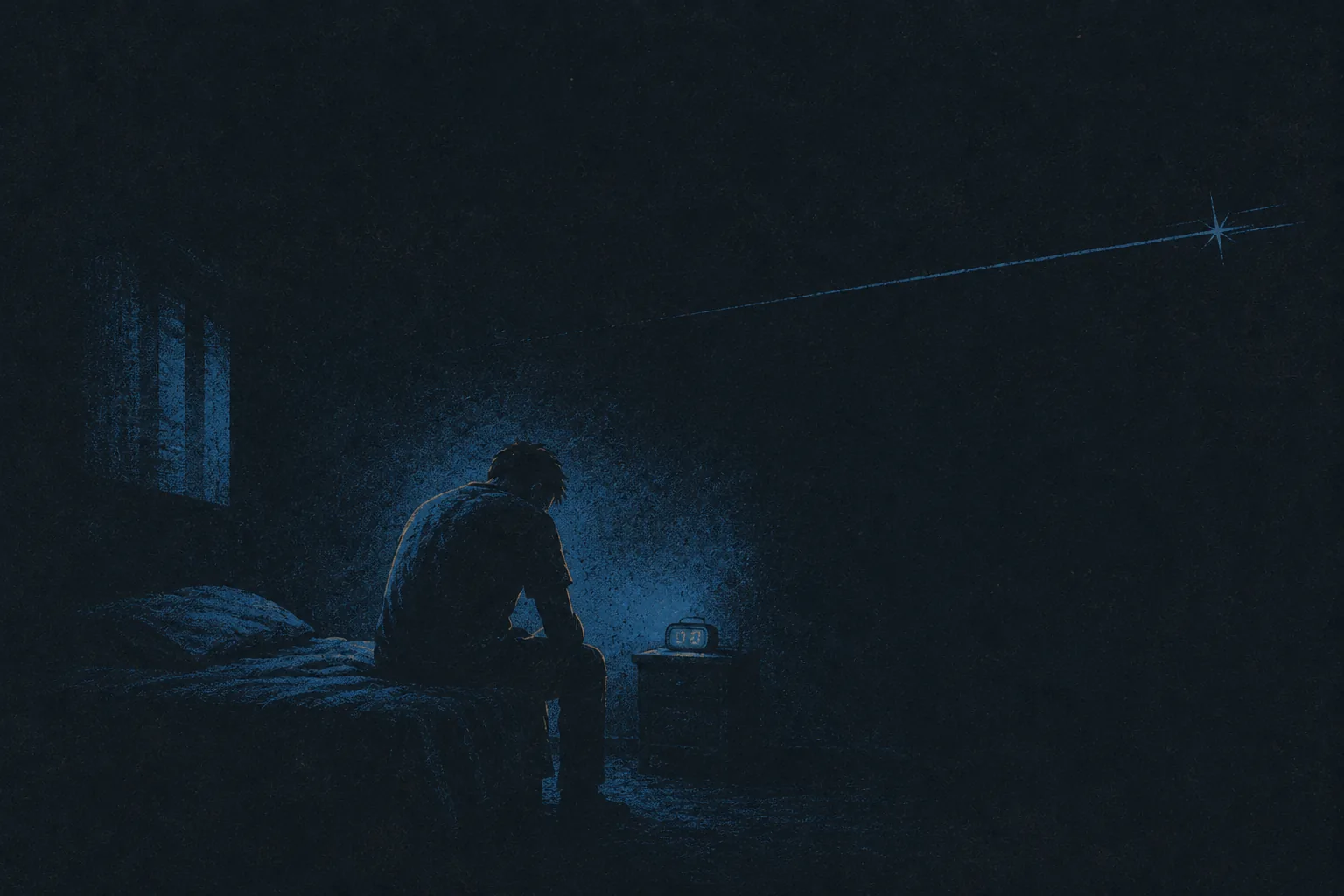
The day winds down. The house goes quiet. And right on cue, the ringing steps forward to fill the silence. By 3 a.m. you're staring at the ceiling, doing the math on how wrecked tomorrow's going to be.
Here's the part nobody warns you about. It doesn't hold steady. Every bad night leaves the whole system more on edge — so the ringing comes earlier, and sharper, than the night before.
You've been told to mask it. Wait it out. "Learn to live with it." You've tried all three. And it's still 3 a.m.
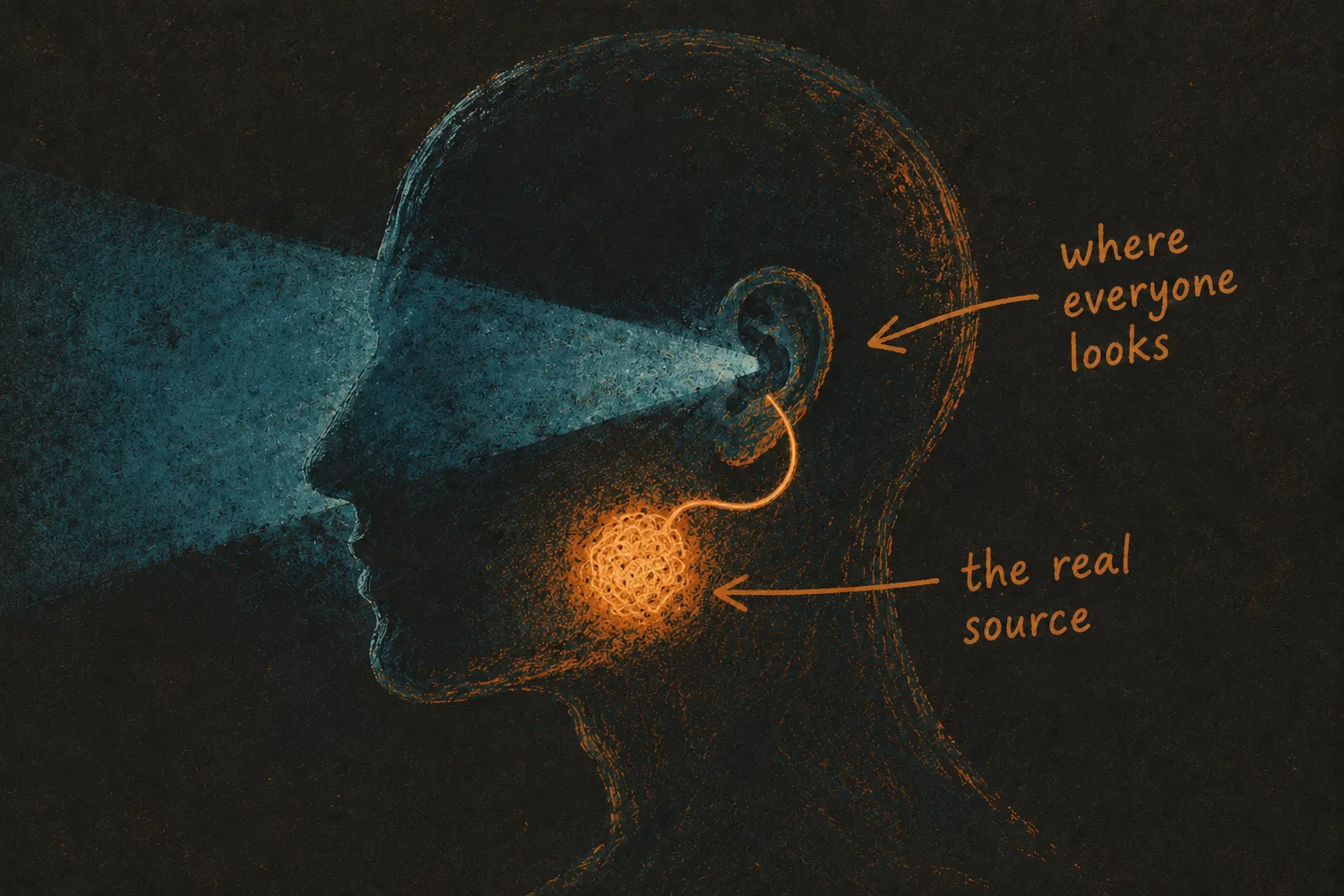
Think about where they kept sending you. Back to your ears. Drops, hearing aids, scans, and finally a shrug — "nerve damage, nothing we can do." And through all of it, the ringing stayed exactly where it was.
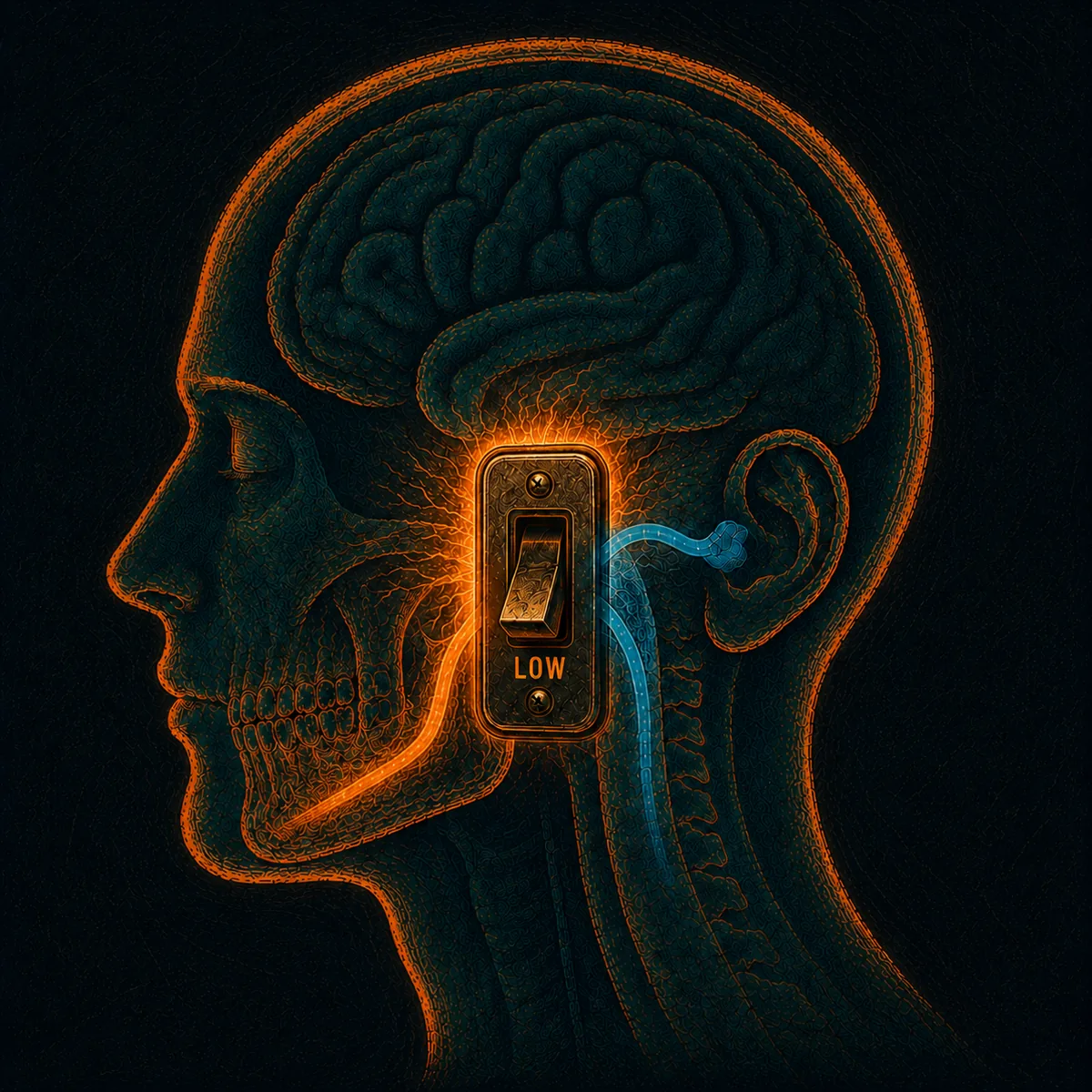
So here's what they skipped. Deep in your brainstem, there's a junction where two sets of nerves meet. One carries sound from your ears. The other carries tension from your jaw and neck. And they cross.
Which means when your jaw stays clenched — and after years of bracing against this thing, it always is — it leans on that junction and pushes the volume up.
That's the switch. And that's the answer to the question no specialist could ever give you: why the ringing screams loudest at the exact moment the house goes quiet.
Three quick moves. Do them in a quiet room — and listen closely. The shift is real, but it only lasts a few seconds, so pay attention while you move and right after.

Clench. Bite your teeth together — hard — for five seconds, and listen to the ringing as you do.

Push. Slide your lower jaw forward, out past your top teeth, and hold for five.
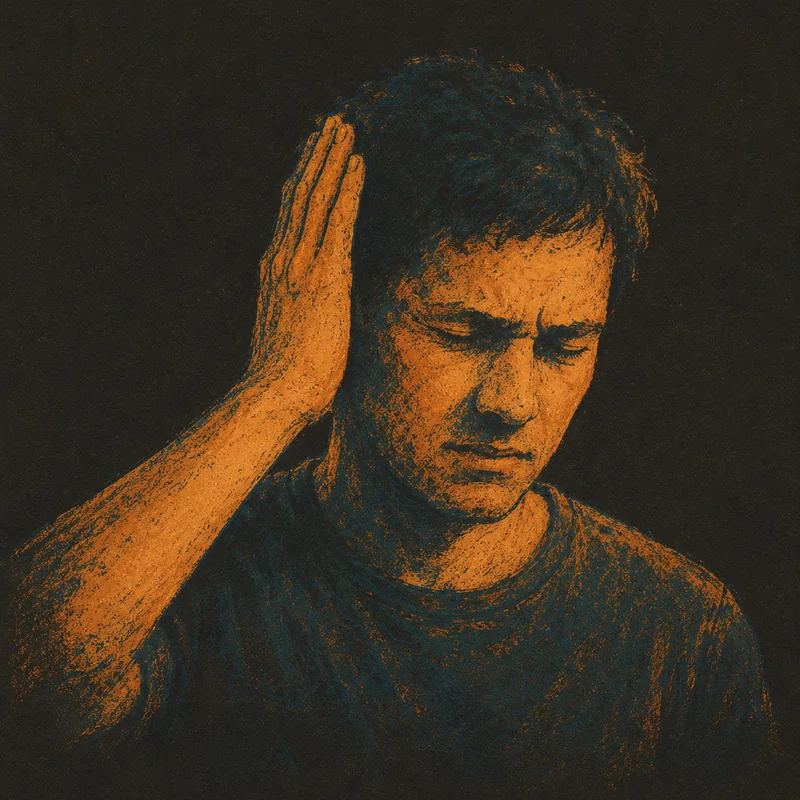
Press. Press the heel of your hand against the side of your head and push gently for five.
Did the tone shift on any of them — louder, sharper, higher, or just different?
If it moved even slightly — on even one move — you just proved it on your own body: the ringing isn't sealed inside your ears. It's riding on the tension in your jaw and neck — and tension is something you can let go of.
And you're not alone. When researchers ran these same movements, up to 8 in 10 people with tinnitus could change their ringing exactly this way.
If nothing moved — on any of the three — this probably isn't your mechanism, and we'd rather you close this page now than spend $27. That's exactly why we put the test first.
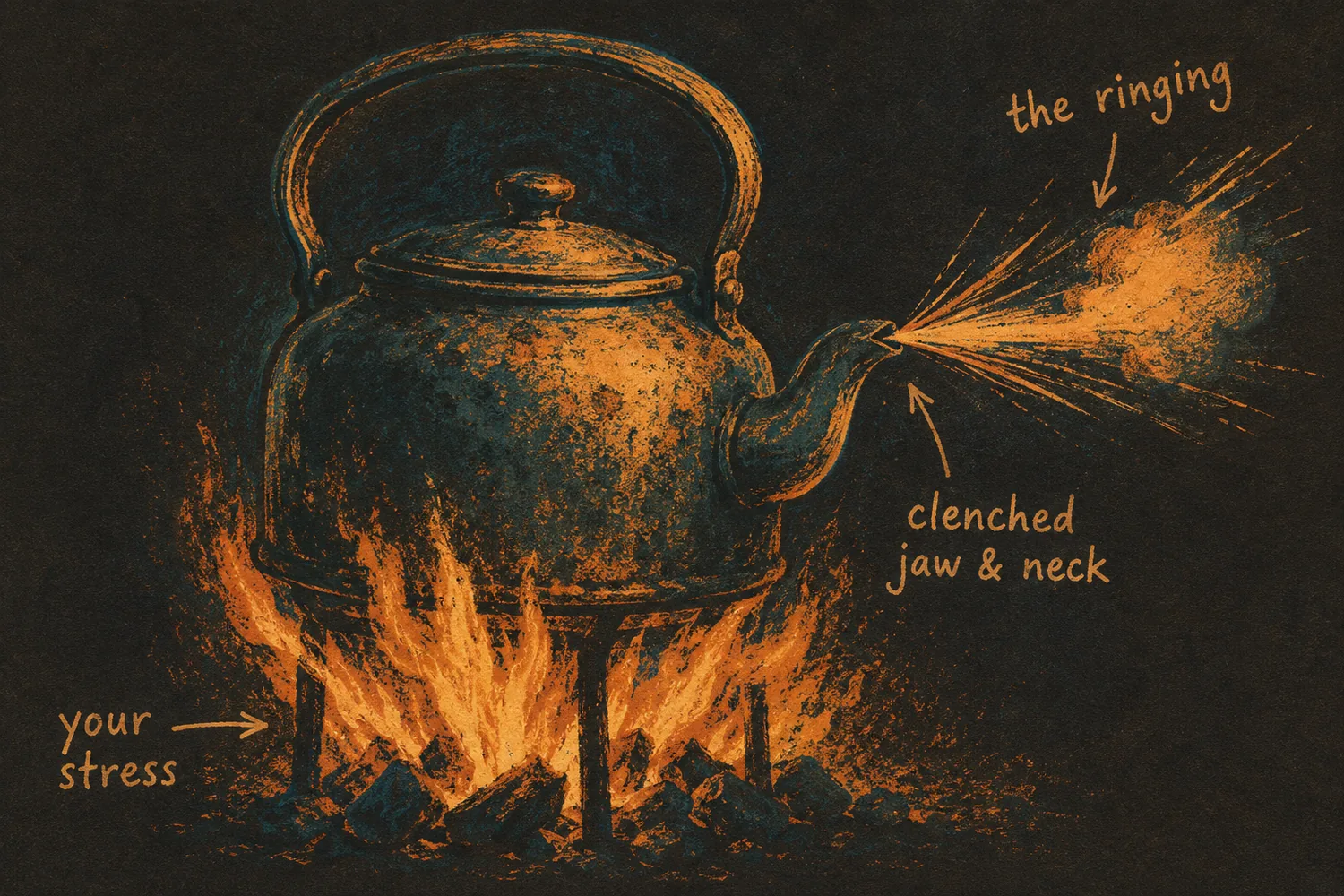
You just felt that switch move. So let me show you what's happening behind it. Picture an old kettle on a wood stove. Years of stress have turned the fire up high. And your clenched jaw? That's a hand squeezing the spout half shut. Steam that should drift out quietly gets forced through a narrow gap — and screams. That scream is your 3 a.m. tone.
Which tells you something important. The ringing was never the kettle breaking. Loosen the spout, let the fire settle to embers, and that scream drops back to a hum. You don't put the fire out — you just let it burn down.
And here's why the night is the cruelest part. Two things gang up on you at once. Your stressed nervous system clenches the jaw harder in your sleep — and the quiet house strips away every other sound that used to cover the whistle. Hand on the spout, nothing left to drown it out. No wonder it's loudest at 3 a.m.
And this isn't our theory. Dr. Susan Shore at the University of Michigan mapped this exact junction and showed that working on it measurably lowers the tinnitus burden. Then researchers at the University of Erlangen proved the other direction: when chronic tinnitus patients simply relaxed the jaw, the brain's own quiet-down activity rose — and the ringing got weaker and less annoying within moments. The Silence Switch is simply how you do that on purpose, every night.
Here's why everything you've tried has failed. Every single fix aimed at the wrong part of the kettle. And once you can see the kettle, you can see exactly why each one missed — and why one part never got touched at all.
They pour more sound into the room to drown the whistle out. The spout's still pinched, the fire's still high — you've just stacked noise on noise. Take the earbuds out, and the whistle's right there waiting.
They turn the steam up, amplifying sound to fill the gap. For a brain already cranking its own volume, louder isn't calmer — and they never go anywhere near the spout.
They go hunting for damage to repair in your ear. But the kettle isn't broken. It's a pinched spout on a fire turned too high — there's nothing in the ear to fix, so there's nothing for them to do.
Months of being coached to ignore the whistle. It never touches the burner or the spout — it just asks you to stop hearing a scream that's still screaming.
You don't cut a kettle to stop it whistling. There's nothing structurally broken to remove.
See the pattern? Every one of them went after your ears, the steam, or your patience. Not one touched the spout — the clenched jaw holding the whistle wide open. That's the one lever nobody ever put in your hands.
And once you can see the kettle, the fix is almost embarrassingly simple. Nothing aimed at your ears. Just the two moves no one ever had you make, in the right order: take the hand off the spout, then let the fire burn down.
That's the whole job — and it's exactly what the next ten minutes are built to walk you through.
It's two short guided sessions — ten minutes total, done in the dark right before bed. You just follow along. Nothing to learn, nothing to memorize, no way to get it wrong.
A gentle guided relief for your jaw and neck — slow and easy, the screen shows you exactly what to do. As the tension lets go, you'll feel a warm heaviness spread down the side of your face and into your neck. That's the valve easing open — your body confirming it's working.
A slow eye movement and a specific breathing pattern that switch on your vagus nerve — your body's own "stand-down" signal. It's the same breath-driven pathway Harvard researchers built into their vagus-nerve work: the calm signal rides out on your exhale. The burner drops from a roar to embers.
 Masseter (jaw)
Neck
Masseter (jaw)
Neck
The guided session walks you through loosening the masseter — your main clench muscle — and the strap muscles down the side of your neck. These are the exact spots that hold the day's tension and lean on the hearing junction. As they let go, a warm heaviness spreads down the side of your face.
Start tonight Vagus nerve
to heart & lungs
Vagus nerve
to heart & lungs
A slow eye movement paired with a paced exhale switches on the vagus nerve — your body's own "stand-down" signal. The calm travels down the nerve toward the heart and lungs and rides out on your breath, the same breath-driven pathway in Harvard's vagus-nerve work.
Start tonightThis is why it works where "just listen to this" never could: you're physically taking the hand off the spout, then telling the fire to settle. Small, easy moves — you're just getting out of your body's own way. It's the same switch that's been stuck turning the ringing up for years, finally moving the other way.
Not a video you watch — the nightly system the Institute built to reach that switch on purpose. Every second sequenced from the research above, then stripped of everything that doesn't move the tone.
In plain terms: two five-minute guided sessions you press play on in the dark, plus a ten-second nightly tracker. That's the whole thing — nothing to read, nothing to memorize, no app to learn.

Your full ten-minute nightly ritual, yours to keep on any device the moment you join. We did the hard part so the only effort left is pressing play.
Guided session 1 · 5 min
Your first guided session — five minutes for the jaw and neck. The screen shows you exactly what to do.
 Guided session 2 · 5 min
Your second guided session — five minutes of guided breathing that winds the body down for sleep.
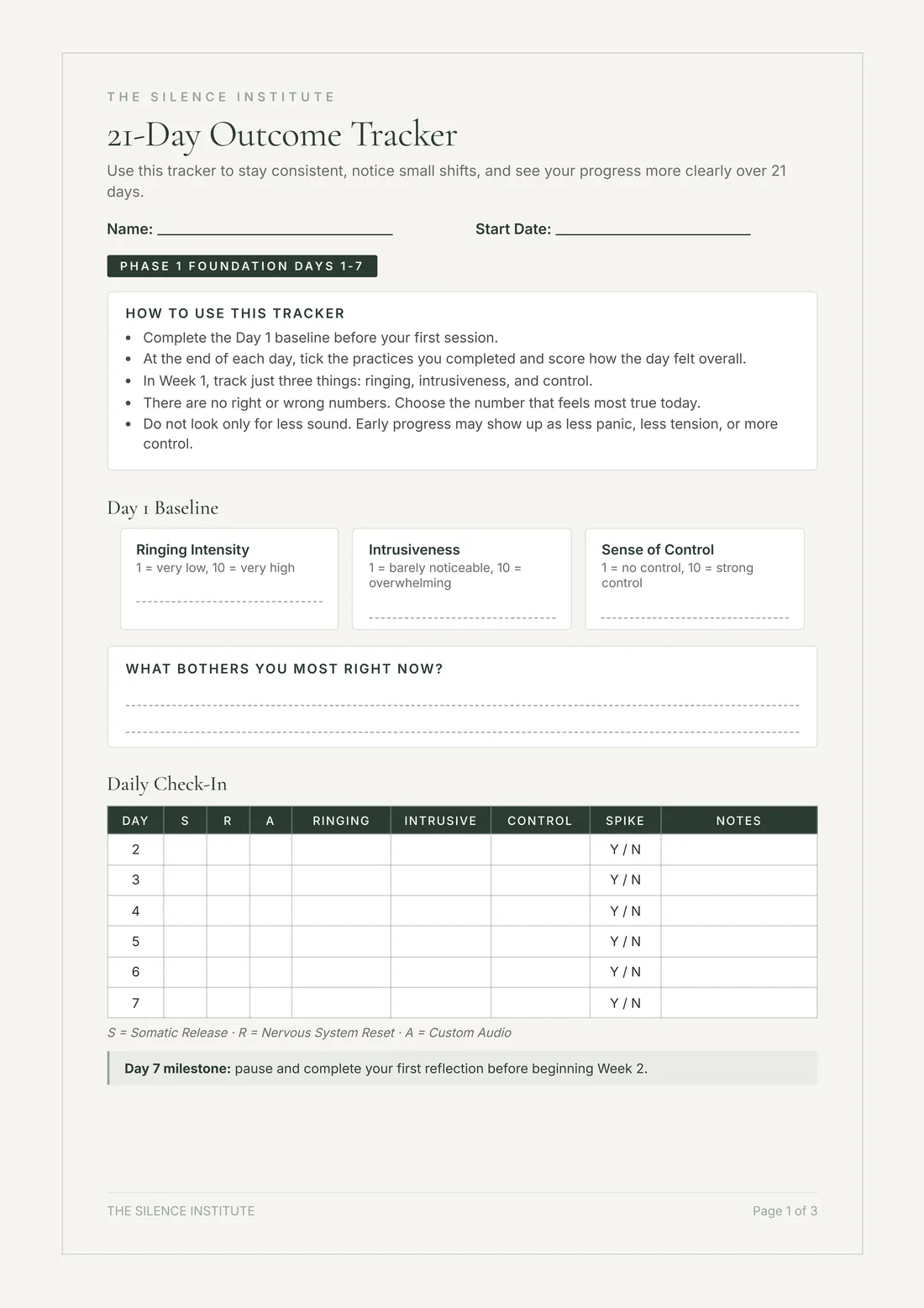 Nightly tracker · 10 sec
One number, morning and night — watch the tone fall in your own handwriting.
You can't. You follow along for ten minutes in the dark. Nothing to memorize, nothing to get right.
No — and anyone selling you a tinnitus cure is lying to you. This gets your jaw off the spout so the tone drops to a hum and you fall asleep tonight. That's all it has to do.
It's ten minutes lying down before bed. It's the easiest thing you'll do all day.
The switch isn't ours. It's how hearing is wired — mapped in published neuroscience.
The UCSF authority on brain plasticity. His verdict on the research pinning the ringing to the brain — not damage in your ears: the clearest picture yet of how the cortex itself makes the sound. Which is why nothing aimed at your ears ever worked.
View the study ↗Mapped the exact junction where your jaw and your hearing cross in the brainstem, and showed that working on it measurably lowers the tinnitus burden.
View the study ↗Showed that slow, paced breathing can switch on the vagus nerve's calm signal — the same "stand-down" pathway the Burn-Down session uses.
View the study ↗Found that releasing the jaw triggers an immediate rise in the brain's own quiet-down activity — the tone softens within moments.
View the study ↗The Silence Switch doesn't reinvent any of this. It just puts it in your hands, ten minutes a night.
You've spent years, and probably a small fortune, chasing this thing. So we're not going to ask you to gamble another dime on hope.
Here's the deal instead. Try The Silence Switch for 30 nights. Do the switch on at least seven of them and write your number in the Kettle Journal — that's the only ask, because it's the only honest way to know if it's working for you. And if your nights aren't calmer? Send one email. Every cent comes back, and you keep the journal.
No forms. No hoops. No "are you sure?" Either it quiets your nights, or it costs you nothing. Which means $27 was never really the question. The only question left is whether you'll give your jaw ten minutes a night for one week — when the only risk still on the table is ours.
Those cover the whistle. This loosens the spout. One stacks more sound on top of the problem; the other reaches the muscle creating it. That's why the quiet stays quiet after — instead of the moment you take the earbuds out.
No. It's wiring, not wear. The junction responds to being worked the same way at year twenty as at year two — and a jaw that's braced that long has the most tension to give back.
Many people feel the warm heaviness in the jaw during the very first session — that's the spout easing open. The tone settling, and the nights getting calmer, builds over the first week. Some nights move more than others; that's why we give you 30.
No. Just ten minutes, lying down, in the dark. Headphones are fine if you like them, but nothing's required.
No. One payment of $27, yours to keep, on any device. No rebills, ever.
The house will go quiet. The ringing will step forward to fill it. The only thing you get to decide is whether you meet it the way you have for years — bracing, negotiating, waiting for 3 a.m. — or whether you give your jaw ten minutes, take it off the spout, and let the day burn down.
Your jaw has been turning the ringing up for years. The rest is just learning to turn it down — on purpose.
The Silence Institute. Let the day burn down.